Showing posts with label Ohio. Show all posts

Sunday, June 16, 2013

Huron Suffers Severe Loss From Big Fire


From the Sandusky Evening Star, Saturday, April 18, 1903

 
The Losses:

Hermes & Scott, fish warehouse, $5,000; no insurance

W.C. Heyman, fish warehouse and contents, $6,000; no insurance

W.C. Heyman, ice house, $500; no insurance

C.A. Weichel, stock of ice, $500; no insurance

V. Fries estate, barn and lumber, $1,000; fully insured


            For a time, Friday afternoon, the village of Huron was threatened with a most disastrous fire, which seemed likely to sweep the river front and spread to business blocks.  The dying down of the wind, however, prevented such a disaster, and the blaze was practically confined to four buildings, the lumber yards being saved.  The total loss is estimated at about $12,000 or $13,000, with but little insurance being given above.

            The fire broke out in the fish and twine warehouse of Hermes and Scott, on the river front, near the Fries lumber yards, and spread rapidly.  A half dozen people saw the blaze break out about 4:30 and turned in the alarm.  How the fire started no one knows.  A puff of black smoke suddenly burst out of a window on the first floor, and in another moment the building was a mass of flames.  No one had been near the building, and no fire was near the place, so far as is known.  The day before, a large quantity of nets and twine had been freshly tarred and stored in the building, and this burned like tinder.

            Huron has no fire department to speak of.  There is one little hand engine and a supply of hose, and a volunteer company, of which Henry Shaffer is chief.  The firemen turned out in good order, and soon had the little engine manned, but the sickly stream of water thrown was of no avail.  The flames rapidly spread to the large fish warehouse of W.C. Heyman, and also to Heyman’s ice house.  When it was seen that the fire was likely to spread to the lumber yards, an urgent appeal for help was sent to Sandusky.  It required time to make up a special train and get the big steamer loaded on, but a quick run was made and by 5:45, the Sandusky firemen were on hand and ready for business.  By that time, however, the fire was well under control, and there was nothing to do but turn a stream onto the ruins and keep the fire in check as a precaution against a possible high wind.

            Huron will feel the loss by fire severely.  In both fish houses, there were quantities of twine which were destroyed.  The ice, owned by C.A. Weichel, was considerably damaged and may be worthless.  It is not likely that the warehouses will be rebuilt, and this makes the loss the more severe for Huron people.  They consider themselves fortunate; however, in that the fire came at a time when there was little wind, for had the strong north wind of the last few days been blowing, nothing would have saved the lumber yards and many buildings in the vicinity.

            It was the hard work of the Huron firemen and citizens that saved much loss in the lumber yard.  Before the steamer arrived from Sandusky, the blaze had spread to a barn adjoining the lumber piles.  On the second floor of this barn was stored a quantity of fine lumber.  As the lower part of the barn was burned away, the floor fell.  Then men went to work tearing down parts of the burning building and removing the lumber.  One pile of lumber was also torn down, and this prevented a further spread of fire.  At one time, the large lumber ware house was on fire, so great was the heat, but this blaze was extinguished.  The loss to the Fries estate will not exceed a thousand dollars.

            Two vessels, the tug Industry and the barge Columbia were lying in the river adjoining the fish houses, but they were not in much danger at any time.

            The fire attracted a great crowd of people, and cars running to Huron from both east and west carried many people.  When the Sandusky steamer was started, there was a novel sight for the Huron folks.  Their chief regrets that the firemen did not reach them earlier.

Monday, March 11, 2013

More on Captain Fairbanks Church


The July 19, 1836 edition of the Norwalk Reflector details the near completion of Fairbanks Church's second ship of the season, the DeWitt Clinton.  As previously stated, Captain Fairbanks Church was a prolific ship builder in Huron, Ohio, in the late 1820s and 1830s.  Further information on the eventual fate of the DeWitt Clinton, can be found here:http://images.maritimehistoryofthegreatlakes.ca/28054/data

Here is a great article on the fate of another ship built by Fairbanks Church, the Great Western: http://www.examiner.com/article/the-burning-of-the-great-western

Thursday, March 7, 2013

Huron’s Port was Important to the Town’s Development

Mouth of the Huron River
Huron, Ohio, May 26, 1832 from the Norwalk Reflector

            The rapidly increasing business of this place begins to arrest the attention of our own citizens, as well as travellers and emigrants, who feel an interest in the settlement of Huron County.  Since the Steam Boat Sheldon Thompson was built at this port in 1830, it has been noted as one of the best places for ship building on the western Lakes.  Since which, the following large Schooners have been built and fitted out at this place, viz. the Marengo, launched in June, 1831- burthen 105 tons;- the Austerlitz, launched in April, 1832- burthern 131 tons, built by Capt. Church and owned by O. Newberry, Esq. of Detroit;- the Prince Eugene, launched in May, 1832- burthern 101 tons, built by Capt. Parsons, and owned by Mr. T. Jackson of Huron;- the Buffalo, launched in May, 1832- burthern 161 tons;- and a new Schooner, now on the stocks, which will be launched about the 20th June- burthern 130 tons;- the two last vessels owned by Messrs. Standart & Hamilton of Milan, and built by Capt. Church.  They are all built of the best materials and after the most approved models, and by first rate ship builders;- any country may well be proud of either of them.
            The above mentioned vessels, together with the well know Lady of the Lakes, Louisa Jenkins, Cincinnati, Mary of Milan, Eclipse, and a number of small vessels, too numberous to mention, are owned at this port and Milan, and employed in exporting produce to Detroit and the upper Lakes, as well as to Buffalo and Oswego; and in return bringing merchandize and emigrants from Buffalo;- give to the Port of Huron a name abroad and at home of increasing importance.  It is a well known fact, that this place began its date as a port in 1824; at which time waggons were frequently driven across the mouth of the river on a sand bar, which obstructed the waters of the Huron, and caused them to set back in the low lands of the adjoining country, occasioning innumerable and complicated diseases.  These evils the fostering hand of Government not only removed, but converted the harbor into one of the best and safest on the Lake, by extending piers a quarter of a mile into the Lake, preventing sand from washing into the channel.  To the country generally it is of vast importance, as good roads lead to Milan, and from that village to all surrounding country.  The merchants of Milan and Huron have gone into competition with those of Sandusky city in vending salkt, and purchasing produce, which has reduced the price of the former, and advanced the latter to unreasonable rates.  The farmers feel the effects of this competition to a great extent; many of whom are rapidly increasing in wealth.

            The town of Huron, in a great measure, owes it flattering prospects to the enterprising citizens of Milan; through whose influence and exertions appropriations were made for the improvement of the harbor.  The village of Milan is well situated for trade, and by its connection with Huron by the Huron River, which is navigable up within three miles of Milan, together with its healthy location, will soon become a place of extensive business.  It is in contemplation to connect the two villages, at the head of navigation, by a canal, which will no doubt ere long be carried into effect.  A daily line of Steam Boats, from Buffalo to Detroit, now call at Huron, both on their upward and downward passage, landing and receiving passengers, freight, & c.  A daily line o f Stages has also been recently established, running from Huron through Milan, Norwalk, Mount Vernon, to Columbus.  The large amount of business already brought to the Lake, by this route, exceeds the expectations of its most sanguine friends.

Note: The Milan Canal, which was completed in 1839, brought a period of prosperity to Milan.  The Canal linked Milan to the Huron River and, subsequently, Lake Erie.  Ships traveled along the three-mile canal, and then proceeded to the Huron River and eventually traveled another seven miles to Lake Erie through the town of Huron.  Farmers could bring their grain, hogs, and other goods to market in Milan and save a day’s travel time over less than ideal roads.  Farmers from a 70-80 mile radius to the south, east, and west took advantage of Milan’s Canal.  In its heyday, 600-700 wagons arrived in Milan per day, and as many as 20 sailing vessels were loaded with upwards of 35,000 bushels of grain.  The population of Milan surged from around 280 residents in 1824 to 500 in 1840 to 1,500 in 1850.  Ultimately, the Milan Canal resulted in a major decline in the shipbuilding and exports from Huron. 

Friday, February 22, 2013

The History of Milan, Ohio, the Milan Canal, and Squier’s Inn


     The mid to late 1830s was a period of great prosperity in Milan’s history.  Construction on the Milan Canal began in 1832 and was completed in 1839.  The Canal linked Milan to the Huron River and, subsequently, Lake Erie.  Ships traveled along the three-mile canal, and then proceeded to the Huron River and eventually traveled another seven miles to Lake Erie through the town of Huron.  Thus, farmers could bring their grain, hogs, and other goods to market in Milan and save a day’s travel time over less than ideal roads.  Farmers from a 70-80 mile radius to the south, east, and west took advantage of Milan’s Canal.  In its heyday, 600-700 wagons arrived in Milan per day, and as many as 20 sailing vessels were loaded with upwards of 35,000 bushels of grain.  The population of Milan surged from around 280 residents in 1824 to 500 in 1840 to 1,500 in 1850.  All of this activity in Milan allowed for a variety of businesses to flourish. 

     One of the businesses that was created due to the increased number of visitors to Milan was the Squier Inn and Tavern which was constructed east of Milan by Whitney Squier.  Though no evidence in the form of newspaper ads or articles or other stories in written histories concerning the Squier’s Inn could be located, Milan historian, Wallace B. White, discussed the inn on several occasions during a 1976 interview that was transcribed by Ruth Vogt.  In speaking of the dance floor at the Squier’s Inn, Wallace stated “The dance floor in there is said to have been built so it was springy, and sprang.  Also on the dance floor, they had tracks so that the partitions could be pulled up to make the bedrooms, or pulled back again to make the dance floor.”  The Squier’s Inn was apparently a popular stop for farmers hauling large loads and especially for those farmers who were driving herds of hogs.  The Squier family owned a large property and likely had corrals for the hogs.  According to Wallace “…hogs were quite a commodity.  This old Inn (Squier’s), over there, the drovers used to stop there.  The drovers would come in at night, feed the hogs salt and water them hard, so it would increase their weight when they sold them down here (in town).”
     Whitney kept the Inn with the help of his unmarried daughters.  With the sheer number of wagons arriving in Milan each day and the large number of hogs being driven to Milan, Whitney was able to prosper.  As evidence of Whitney’s prosperity, on the 1850 census he stated that his real estate was valued at $11,000 which roughly corresponds to $323,000 today.  However, the prosperity of Milan soon began to diminish, first due to an outbreak of cholera in 1851.  The town tried to limit the number of visitors, especially to the taverns, because they feared the visitors were bringing cholera with them.  But, the biggest blow to Milan’s economy came with the expansion of the railroad in 1854.  The railroad made transportation of goods much easier and cheaper for farmers who lived in remote areas.  Hence, the Milan Canal was no longer a necessary means of transport.  Though only traces of the Milan Canal can be found, the Squier's Inn still stands as a testimony to the once prosperous period in Milan's history.

Tuesday, January 29, 2013

Value in the Past

I came across this great quote yesterday while doing some research on the history of Lakeside, Ohio, for a chapter in my book on the Hoover Potato Digger and its inventor, Isaac W. Hoover.  This quote sums up why I enjoy doing historical research so very much!


"There is a tendency for the present to disgard all the past and keep only the new. However, backgrounds are fascinating entities as are characters, which have all the illuminating facets of a diamond."
~Eleanor Durr, from Lakeside, Ohio: First 100 Years

Monday, November 19, 2012

Underground Railroad Reminiscences

One of my current projects has given me the amazing opportunity to learn about the Underground Railroad and the incredible events that took place in Erie County, Ohio, and beyond. I found the following account presented to the Firelands Historical Society in 1887 to be particularly moving.

On December 25, 1859 or 1860 when H.F. Paden was a passenger conductor on the old Sandusky, Mansfield and Newark Railroad, he assisted nine fugitive slaves in their journey to freedom in Canada. Paden got the men as far as the Sandusky, Ohio, where he observed the following:

“Between them and their goal lay Lake Erie, its waters congealed by the forces of nature into a mighty bridge, thirty miles across, treacherous withal, liable to be swept by furious winds and cruel blinding storms of snow. To the certain and uncertain places of this bridge, alike unknown to them, with a pocket compass for their sole guide, these men were about to commit themselves, their hopes, their dearest interests, their very lives, with trustful confidence in a God of freedom, for one grand, final effort to achieve ownership of their own bodies and souls.”

Wednesday, September 19, 2012

Jabez Wright: Huron’s Connection to the Underground Railroad


            Huron can take pride in having been the home of an amazing pioneer, civic leader, and integral figure in the antislavery movement, Jabez Wright.  Wright came from New York to the Firelands with Almon Ruggles in 1809.  Wright and Ruggles had been hired to survey the area of the Connecticut Western Reserve that became known as the Firelands.  This land was to be distributed as compensation to those who experienced a significant loss of property during the Revolutionary War.  Wright apparently liked the area and settled on the west bank of the Huron River about 2.5 miles from the shores of Lake Erie, in Huron Township.  On May 11, 1811, he married Tamar Ruggles, niece of Almon Ruggles, and together they had five children: Winthrop, Douglass, Lucy, Abigail, and Ruggles.  Around 1815, Wright relocated to a large parcel of land located on the north side of what is today known as Cleveland Road, West, just east of Rye Beach Road.  On this property around 1822, Wright built the first brick house in Huron Township.  This impressive home contained eight rooms and a basement.

            Wright was instrumental in the development of the Firelands region, and according to his obituary, he was “universally esteemed”.  Further, the 1874 Combined Atlas Map of Erie County states that Wright was “a good citizen, an exemplary Christian, and an enterprising pioneer.”  As evidence of his good character and civic responsibility, Wright was elected as one of the first two county commissioners for the Village of Cleveland and, in 1815, was elected as one of the first three associate judges for the Court of Common Pleas in Huron County (Erie County was carved out of part of Huron County in 1838).  Wright also was elected to serve as Justice of the Peace for Huron Township.  In 1820, Wright lost his bid for Ohio State Representative, but in 1823 he was elected to the position of Ohio State Senator for the Ashtabula District, which included Cuyahoga, Geauga, Portage, Huron, Medina, and Sandusky counties.  Wright served in this capacity for two terms from 1822-1825.  In 1836, he was nominated as the Whig party’s candidate for Representative for the 14th Congressional District, a position which Wright did not obtain.  Wright also worked as a surveyor, land agent, and farmer.

In addition to his public service, Wright’s exceptional character was also evident in the fact that he was one of the first residents of Firelands and the state of Ohio to aid fugitive slaves.  Wright risked his reputation and financial well-being to do what was morally right, though in violation of state and federal statutes.  His large home served as a regular station or depot on the Underground Railroad.  Beneath Wright's farmhouse was a 16-foot wide and 90-foot long tunnel.  Fugitive slaves entered the passage through a trap door in the home's basement and exited into a corn crib located about 100 feet from Lake Erie.  There, these families and individuals awaited the arrival of rowboats that would transport them to vessels headed to Canada and, subsequently, freedom.  Alternately, after resting at Wright’s home, the slaves would make their way to Sandusky or Detroit to await a ship headed to Canada.  In a speech before the Firelands Historical Society in 1888, Honorable Rush R. Sloane described Jabez Wright as follows: “He never failed when opportunity offered to lend a helping hand to the fugitives, secreting them when necessary, feeding them when they were hungry, clothing them and employing them.”  Wright's home was a common resting stop for Josiah Henson, the man upon whom Harriet Beeacher Stowe based her character of Uncle Tom, during his conducting journeys on the Underground Railroad.

            Wright died on December 16, 1840 at the age of 61.  According to an account of his death, he “left his house early in the evening of the 16th December, with the intention of transacting some business in the village, and going out in front of his house for the purpose of getting down to the beach, he fell from the bank, and struck his head against some timber in a crib erected in front of his residence, a distance of eighty feet.  He apparently made every effort to regain the bank, having succeeded in finding his way to the place where his family would usually go down to the lake for water-but the coldness of the night and the loss of blood paralyzed his efforts.  His lifeless body was washed off by the waves and floated opposite the village, where it was found on the morning of the 17th.”  Following the death of Jabez Wright, his sons, Winthrop and Douglass, continued the work of their father in aiding slaves in their bid for freedom.  It is unknown as to how many fugitive slaves found refuge in the home of Jabez Wright, but his name should forever be remembered for his many acts of kindness. 


Wednesday, July 25, 2012

The End of an Era in Huron

History was made today in Huron, Ohio, as the last structure at the former ConAgra site fell.  New history will soon be made as the plans for re-development unfold.  This is an exciting time for Huron!

Monday, July 9, 2012

Rare Eliot Ness Memorabilia Collection


This photo, taken in 1947, is one piece of the Rare Eliot Ness Memorabilia Collection that will be soon be part of an auction conducted by Central Mass Auctions, Inc. The photo was taken in Cleveland during Ness' unsuccessful bid for mayor. This is of particular interest to me because the store in the background was owned by my family. So cool! History truly is everywhere.

Wednesday, May 16, 2012

Huron's Old Plat Neighborhood

Huron's Old Plat neighborhood is an ecletic mix of interesting houses and even more interesting people.  There is an optional neighborhood association, the Old Plat Association, through which social events like an Easter egg hunt, summer picinic, and Christmas carolling events are planned.  Also, there is an annual neighborhood garage sale (This will take place on Saturday, May 19 from 8-2 with 20+ houses participating.).  We also have a self-guided walking tour brochure should you want to stroll around our neighborhood.  Copies of this can be found at the Huron Public Library, the Huron Chamber of Commerce, or online (http://huron.net/pdf/walking%20tour%2007.pdf).

There are a few historic homes for sale in the neighborhood, and we are looking for new homeowners who will cherish these old houses and be true to their history.  Previously, I discussed the house located at 125 Center Street.  This house is still for sale.  Another great house that has recently come on the market is located at 125 Williams Street.  This home, built circa 1838, was the longtime home of Rev. Samuel Marks.  Marks was the minister at Christ Episcopal Church in Huron for many years and was well-loved by the entire community.  The current owners have emassed quite a history on Samuel Marks and are willing to share this with the new owners.  Here is a link to the listing:  http://www.realtor.com/realestateandhomes-detail/125-Williams-St_Huron_OH_44839_M33780-97293.  As the president of the Old Plat Association, I am happy to answer any questions you might have about the neighborhood or Huron in general.

Friday, May 11, 2012

Portraits of Huron’s Past: Andrew and Emma (Frye) Linker

            A series of tragic events led Andrew F. Linker to Huron, Ohio, in the late 1800s.  Andrew Phoenix Linker was born on a farm on Galloway Road in Perkins Township on May 22, 1870, to John C. and Margaret Linker.  Andrew’s mother, Margaret, died in 1878, and his father, John, died in 1888 after being run over by a train.  Since adulthood, in the legal context, was not reached until age 21 at this time, Andrew came under the guardianship of family friend, Gustavus Graham.  Soon, Andrew came to live with the Graham family and helped maintain their farm at 3419 Cleveland Road in Huron Township (currently owned by the Barnes family).  Further, Andrew became the sole heir of Gustavus Graham after the Graham’s only daughter, Cora, committed suicide in December of 1888.
            In 1902, Andrew married Emma Josephine Frye.  Emma, the daughter of Jacob and Emma Frye, was born in April of 1878, was raised in Huron, and graduated from Huron High School in 1894.  She attended college in Berea, Ohio, where she obtained a teaching certificate.  Emma taught in a one-room school house in Huron prior to and after her marriage.  After Andrew and Emma’s wedding, the newlyweds lived with the Graham family.  Andrew and Emma were blessed with three children, Lurella Belle born in 1904, Ivan Graham born in 1905, and Donna Rose born in 1921.
            The Linkers were quite active in the community and served on many committees.  Their involvement included the Erie County Grange, the juvenile Grange, the Women’s Council of National Defense, the County Health League, the Erie County Fair, the Knights of Pythias, the Rye Beach Food Club, the Farm Bureau, and the Sandusky Library Trustees. 

            Tragedy visited the Linker family when Ivan Linker died in July of 1919, at the age of 13.  Ivan had been swimming with some friends at Rye Beach.  The waves were large and the strong undertow caught Ivan and pulled him out of reach of his friends.  His body was not recovered until the following morning. 
            Andrew’s primary occupation was farming; yet, as the hard times of the Great Depression overtook the country, the Linkers, like most American families, could not survive on farming alone.  Around 1930, the Linkers opened their home to tourists as the Ridgewell Inn.  In addition, two chicken coops that sat north of the house were converted to cabins and then rented to tourists.  Later, the Linkers added a gas station to their offerings, which was located across the street on the corner of Cleveland Road and Camp Street.  Later, the Ridgewell Inn also offered tennis courts and a miniature golf course for the guests.  The Linker’s continued to welcome tourists into their home until Andrew’s death in 1942.

            After Andrew’s death, Emma remained in her home for the next eight years.  She was having difficulty maintaining the property and her daughters encouraged her to sell.  Being fiercely protective of her home, Emma would not sell the property to just anyone.  She especially would not sell her home to someone that intended to turn the house into a liquor establishment because she was strongly opposed to the use of alcohol.  In 1950, Harold Barnes was looking for land along the lakeshore upon which to grow roses.  Emma agreed to sell the property to Harold since his intentions were agricultural.  After selling the property to Harold, Emma moved to Sandusky.  She remained in Sandusky until the time of her death in 1959.  Emma was buried with Andrew and Ivan in the Oakland Cemetery in Sandusky.

Saturday, March 24, 2012

HOOVER POTATO DIGGER T-SHIRTS

Hoover Shirts-

The decal on the shirt is a duplicate of the decal that was on each digger as it left the Hoover Manufacturing Company in Avery, Erie County, Ohio. Sizes available are Adult M, L, XL, XXL (add $1 for XXL). Please message or call me if you are interested in purchasing a shirt. Limited quantities are available. The cost is $16 (plus $5.15 shipping, if necessary). Online ordering will be available soon.

Friday, March 9, 2012

Pied Piper Ice Cream in Huron, Ohio

A small town just is not the same without a local ice cream stand. The Pied Piper in Huron, Ohio, has a long history and a big following. Here is its story that I published in the March 8, 2012, issue of Huron Hometown News: Pied Piper to Open March 14 Despite the crazy weather and the lack of a true winter, one thing residents of Huron can always count on as a harbinger of spring is the opening of Pied Piper. The official opening for 2012 is only a few days away and preparations are underway! The Pied Piper has been a fixture in Huron since 1952 when it was opened by Ellsworth and Helen Piper. According to Sheila Ehrhardt, the Pipers operated the Dairy Bar, a full-service restaurant that was located on Main Street in Huron. Ice cream was a big seller at the restaurant, and the children often followed Mr. Piper over to the ice cream cooler in mass to make their selection. Hence, Mr. Piper was frequently compared to the legendary Pied Piper. Thus, the name, Pied Piper, seemed fitting for the Piper’s new ice cream stand which they built at the corner of Cleveland Road and Huron Street. The Piper’s operated the Pied Piper for a few years before selling it to Carl Wechter. This was a fitting match since the Wechter family had long been in the dairy business. The Pied Piper has been in the Wechter family ever since. For the past approximately ten years, the Pied has been owned by Chris and Kelly Wechter. According to Chris Wechter, visitors to the Pied will not see any big changes this year, but all of the favorites will be back. So, if you are dreaming of a Nut Dip or a Turtle Sundae or even just a small cone with a face, you will not have long to wait!

Friday, February 24, 2012

Reminders of the Past: The Fox Road Schoolhouse, Huron Township, Ohio


One-room schoolhouses dot the landscape of Ohio and provide a reminder of what life was like for the children of rural areas, including Huron Township, at the beginning of the 20th century. Sadly, only two of the more than eight, one-room schoolhouses that once stood in Huron Township remain.

As early as 1841, a schoolhouse stood on Fox Road just west of Camp Road in Huron Township. In September of 1841, Squire Barrett sold a small plot of land in the north part of Lot 9, Section 3 to Huron Township for school purposes. As the population of Huron Township grew, so did the number of children attending the rural schools. In the early 1860s, there was an average of 25 students attending the school on Fox Road, known as the Sub-district No. 8 School. Hence, a new and improved schoolhouse was needed to accommodate the growing number of students.

In 1868, the director of the Sub-district No. 8 School, George W. Harris, suggested that a new schoolhouse be constructed in his district just to the west of the original schoolhouse. Hence, in May of 1868, the Board of Education of Huron Township resolved that a tax would be levied on all of the property of Sub-district No. 8 in the amount of $500, and a tax would be levied on all the taxable property of the Township (village exempt) in the amount of $700 for the purpose of purchasing a lot, building a 24’ x 30’ brick schoolhouse, digging a well, and fencing the ground in Sub-district No. 8. By April of 1869, the new schoolhouse was well underway. Unfortunately, the $1,200 in taxes that was collected from the residents of Huron Township was not enough to complete the new schoolhouse. Therefore, the Board of Education levied another $900 tax. The new schoolhouse was likely ready for use by the fall of 1869.

In 1868, a vote was put to the people of Huron Township and Huron Village to decide whether or not to build a central high school. The voters in the township voted against the measure; however, the people of the village voted in favor of it. Though defeated in 1868, efforts to centralize the schools continued nonetheless. In 1886, Huron built a large school in the village on the corner of Williams and Shirley streets. The younger grades were composed primarily of students residing in the village, but high school students came from all over the township.

In the early 1900s, August Scheid was appointed director of the school in Sub-district No. 8. Mr. Scheid, who had several children in the district, was a strong proponent of centralized schools. In 1911, Mr. Scheid personally provided the means for children to be brought into the village for school by purchasing a bus to transport students from Sub-District No. 8 into Huron each day. Mrs. Scheid designed the bus, and it was manufactured in Sandusky. Further, the Scheid’s son, Lyndon, who was to attend Huron High School, would be the bus driver. Hence, the schoolhouse in Sub-district No. 8 was no longer in use after September of 1911. A few of the other one-room schoolhouses survived the centralization effort for a short time, but all eventually succumbed.

From 1911 until 1941, the schoolhouse in Sub-district No. 8 sat vacant, but was still under the ownership of the Huron Township Board of Education. During the 1930s, the owner of the land upon which the schoolhouse sat allowed their pigs to use the structure for shelter. The once lovely schoolhouse was now in shambles. In March of 1941, Thurman, Katherine, and Emory Fox purchased 196 acres of land, including Lot 9, from the People’s Loan and Savings Company. The People’s Loan and Savings Company had recovered the property in 1931 in a suit against August Scheid who owed them $47,535. The Fox family likely challenged the Board of Education of Huron Township for ownership of ‘the schoolhouse lot’ since the schoolhouse was obviously not in use as a school, and, therefore, the land upon which the schoolhouse sat was supposed to revert back to the land owner. In June of 1941, ‘the school house lot’, containing 0.65 acres, was subsequently sold to Dennis C. Fox. By the time Dennis Fox came into possession of the schoolhouse, all of the windows and doors were gone. Yet, Mr. Fox had a vision for the old schoolhouse which included rehabilitating it and making it his home. Since that time, many others have made improvements to the schoolhouse and have called it home, but yet have lovingly respected the house’s unique past.

NOTE: Historical Research Partners was hired in 2009 to research the history of this great schoolhouse, now a home.

Wednesday, February 1, 2012

Vaudeville and Kelleys Island, Ohio

Toward the end of the 19th century, Kelleys Island was a playground for the wealthy, whose visits often lasted several weeks to several months of the summer. Many of these wealthy visitors to the island stayed at the Himmelein Hotel. The Himmelien, like other former hotels on the island, offered exclusive amenities that enticed the elite, such as third-floor accommodations for patron’s servants.

John Himmelein, born on the island in 1868 to hotel proprietors, Johann and Johanna Himmelein, helped with his family’s hotel until approximately 1886, when he left home to attend business college in Evansville, Indiana. Upon completion of his studies, John returned to the island to assist with the hotel operations. There, he was introduced to various Vaudevillian acting companies that lodged at the Himmelein Hotel during visits to the island to practice their repertoires. John’s growing intrigue with the entertainment industry would eventually lead to a new career.

In 1890, John left the family hotel business and began working with Howard Wall’s Ideals Stock Company as the company’s agent. Soon, Wall and Himmelein formed a partnership with Wall focusing on the shows and Himmelein focusing on the business. By the start of the 1892-1893 season, Howard Wall and John Himmelein had organized two complete acting companies, the Robert Wayne Theatrical Company, managed by John, and The Ideals, managed by Wall.

By December of 1892, Himmelein’s company was faltering, and John decided that he needed to hire a soubrette. He learned of a young actress named Bertha Wiles, whom he hired. Bertha Wiles, born in 1869 in Lawrenceburg, Indiana, graduated from the Cincinnati College of Music and first pursued an operatic career with the Spencer Opera Company of St. Louis. Using the stage name of "Beatrice Earle," Bertha soon expanded her repertoire and performed as a dramatic actress, comedian and vaudevillian. Her contributions to the Robert Wayne Theatrical Company, beginning in the 1893-1894 season, resulted in great success for John Himmelein and lead to a life-long partnership. On June 6, 1894, John and Bertha were married at the English Hotel in Indianapolis, after the company’s regular evening performance. By the start of the 1894-1895 season, John Himmelein had purchased Howard Wall’s company and thus began John A. Himmelein ‘s Imperial Stock Company, also known as The Ideals.

Despite his travels, John Himmelein never lost his love for Kelleys Island. In 1905, John and Bertha purchased a choice lakefront lot on the island and constructed a grand home. Bertha christened the home, Cricket Lodge, after one of her favorite stage portrayals from the children’s play, Fauchon The Cricket. While most of the year was spent traveling with their stock company, the Himmeleins always summered at Cricket Lodge.

On December 28, 1909, the Himmeleins only child, Dorothy, was born in Sandusky, Ohio. Thereafter, Bertha left the stage as a full-time actress. Also in 1909, John Himmelein began directing operations of his stock companies, then considered the largest stock-show operation in the country, from New York City. On November 28, 1930, Bertha gave her final stage performance as Mrs. Schultz in the Robertson Young Players rendition of Mrs. Wiggs of the Cabbage Patch at the Sandusky Theater. However, despite her retirement from the professional stage, Bertha continued to entertain family and friends for the rest of her life. She was often known to begin performing at any given moment, an attribute much enjoyed by her grandchildren.

At the end of 1930, John Himmelein shut down his stock companies, and his reign as “King of the Repertoire” ended with the advent of the movies. Several of the theaters owned by the Himmeleins were subsequently converted to movie houses. In 1942, after 52 years in the theater business, John Himmelein officially retired.

Throughout his life, John Himmelein owned 10 stock companies, five of which were traveling companies, while the other five were permanent companies in Arizona, Colorado, Washington, Texas and Maryland. He also owned two theaters in Sandusky, one in Elyria, Ohio, and financed the building of a theatre in Tiffin, Ohio. In addition, he served as a Sandusky City Commissioner, an officer in Sandusky’s Commercial Bank, and as Vice President and Director of Sandusky’s Western Security Bank, which he helped to found. Bertha Himmelein was an accomplished singer and actress who garnered glowing reviews and was behind much of the success of her husband’s first stock company. On October 6, 1955, Bertha Himmelein died at the age of 86. John Himmelein died on July 23, 1956 at the age of 88.

After John Himmelein’s death, ownership of Cricket Lodge was passed to the Himmelein’s daughter, Dorothy Himmelein Sun. In 1984, a year after her husband’s death, Dorothy Sun sold her treasured family home to Frank and Christine Yako. In 1985, the Yakos opened the doors of their home as Cricket Lodge Bed and Breakfast. Over the past 26 seasons of operating the bed and breakfast, the Yakos have become year-round residents of Kelleys Island, welcomed guests who now return as long-time friends, and continue to host visitors to their fine, historic home. Throughout this time, the Yakos have always respected their lovely historic home and have embraced its history, while becoming part of its history themselves.

Photos of Cricket Lodge and the Himmeleins can be found on the Kelleys Island Historical Society's website: www.kelleysislandhistorical.org.

Tuesday, January 24, 2012

John Munson Boalt- A Life of Tragedy and Triumph


John Munson Boalt was born in Norwalk, CT, in 1814. His family settled in Norwalk, OH, in 1816, and then moved to Sandusky, OH, in 1824 where his father opened the Steamboat Hotel. In 1826, John’s father died, and the family returned to Norwalk. At the age of 14, John was orphaned; yet, he was an industrious young man, and soon found employment in Sandusky in the grain and shipping industry.

In 1842, John married Sarah Follett. Sadly, Sarah died in 1844 during childbirth, and their infant son, Edward, died six months later. John served on Sandusky’s first two city councils in 1845 and 1846. Around 1850, he moved to Milwaukee, WI, and then to Winona, MN. John returned to Sandusky in 1866 as a wealthy man and ordered construction of a new home located at 631 Wayne Street. The grand, Italianate-style home took two years to complete. John heavily invested in the Sandusky Wheel Co., a large producer of carriage wheels, and was named president in 1867. Upon completion of his new home in 1868, John again married, taking for his bride Francis (Fannie) Griswold. Through this union, three children were born, two of whom died in infancy.

In 1872, a fire destroyed most of the buildings and finished stock of the Sandusky Wheel Co. Presumably, this is why John filed for bankruptcy in 1873. Though John legally reached an agreement to pay his creditors a portion of what he owed them, he eventually repaid them in full, plus interest. From 1876 to 1880, John served as Postmaster for Sandusky. John died on May 4, 1890, at home at the age of 76. Services were held at the family home. Fannie Boalt moved from her home shortly after John’s death and rented the house until 1898 when she sold it.

Tuesday, October 11, 2011

Prohibition in Ohio

Much interest has surrounded the topic of prohibition due to the documentary by Ken Burns that recently aired on PBS. Interestingly, the stirrings for the prohibition movement began in Ohio. The first organized push toward prohibition began with the Woman's Christian Temperance Union (WCTU) which was organized on December 23, 1873, in Hillsboro, Ohio. Members of the WCTU prayed outside establishments that sold alcohol and often attempted to block the entrances. Members of the WCTU included women from nearly every sector of American life, but the majority of the members came from the middle classes and all had strong ties to evangelical Protestant churches. Though the WCTU is still in existence today, its members were unable to convince the majority of the American public to embrace prohibition.

The next organized movement in favor of prohibition came with the creation of the Anti-Saloon League in 1893. In 1894, Brookfield, Ohio, native and Oberlin College graduate, Wayne Wheeler, was named as leader of the Anti-Saloon League. Wheeler was both passionate about the cause of prohibition and was a well-organized leader. Wheeler’s focus was solely on prohibition, and he effectively applied pressure on politicians to further his cause. Despite Ohio’s strong history in raising prohibition leaders, Ohio did not vote itself dry until 1918. Nonetheless, the sentiment toward going dry in Ohio was always strong, and prohibition was often decided on a local level.

Arthur L. Hoover, son of local inventor, Isaac W. Hoover, and secretary of the Hoover Manufacturing Company of Milan, Ohio, embraced the cause of prohibition. Hoover’s interest in prohibition likely was due to a number of reasons including his job and his faith. Hoover’s livelihood came from the manufacture of potato diggers and other potato-related machinery. Alcohol consumption by employees often led to accidents and decreased productivity. Hoover first became Secretary of the Erie County Vote Ohio Dry Committee and was later named Secretary for the state-wide organization. During his tenure, Hoover discovered a “Blind Tiger” in Huron. (A “blind tiger” was a low-class establishment that illegally sold alcohol. The owner would charge an entrance fee to see an attraction, such as an animal, and then would provide a complimentary drink.) The October 25, 1915 issue of the Sandusky Register reported this incident as follows: “That a “blind tiger” is openly running in Huron is the charge made by A.L. Hoover, chairman of the county temperance committee. Chairman Hoover said Sunday that he reported the matter to the county liquor license commission and asked that its members investigate. “It is a matter of common knowledge in Huron that the “blind tiger” is in operation. The beer sold is obtained from an Erie county brewery.” asserted Hoover.” Apparently, Huron did not readily embrace prohibition!

Prohibition was enacted on a national level on January 17, 1920 after the 18th Amendment to the United States constitution was ratified. After 13 years of increased crime associated with the illegal sale of liquor and no decrease in consumption, the 18th Amendment was repealed, and the freedom to legally choose whether to consume alcohol was again restored to the American people.

Wednesday, June 22, 2011

The Great American Porches of Huron’s Old Plat


Picture this: a hot summer day, a fresh lake breeze, and the chirp of crickets and the song of cicadas. Next, add a dose of tangy lemonade to be shared with good friends. Where would you place this scene? For me, the perfect setting is a beautiful front porch equipped with a squeaky swing and some wicker furniture. For centuries, Americans stayed in touch with friends and neighbors while staying cool on their front porches. The exact origin of the porch is unknown. In America, the addition of a front porch took hold first in the South where its function was two-fold: to cool the house by sheltering the interior rooms, and to provide a place for all social classes to relax and escape the intense heat of the sun.

Following the Industrial Revolution (1820-1870), porches became more commonplace due to greater affluence and machines that made building a house less difficult. In addition, shorter workdays afforded Americans more time to enjoy their families and their homes, while also enjoying the outdoors.

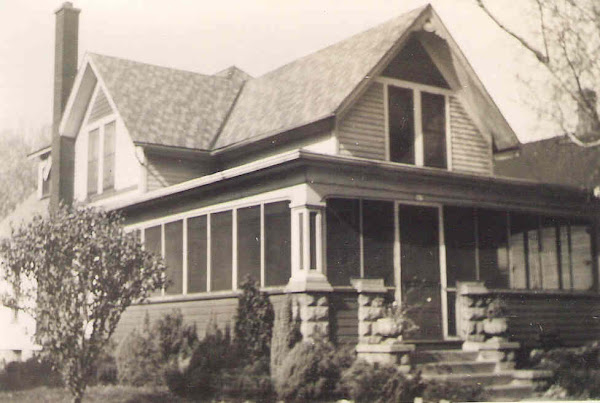
In Huron’s Old Plat neighborhood, the houses with the most impressive porches appeared during the Victorian Period (1840-1900). These porches typically contained elaborate spindle work and were often painted with multiple colors. Porches, which provide a link to the outdoors, fit well with the Victorian Period’s emphasis on healthful living and outdoor activities. Further, the rapid spread of tuberculosis during this period drove people outside in the pursuit of fresh air.

In subsequent years, the popularity of the front porch continued as house styles changed. Most houses for the next 50 years after the Victorian era contained porches. In the Old Plat, front porches are also found on houses built in the American Foursquare and Craftsman styles.

As our modern society progressed and air conditioning and televisions became more common, people withdrew to the indoors. In addition, houses in the post World War II society were being mass-produced without much regard for ‘extra’ architectural elements. People began to crave their privacy and no longer used their porches as a means of staying in touch with neighbors. Though porches did make a comeback for a brief time period, it is doubtful whether they will ever regain the importance they once held. Interestingly, there is a movement to re-establish the popularity of front porches and some planned neighborhoods are even requiring front porches as a means of neighbors connecting with one another. All in all, front porches remain a beautiful reminder of a simpler time and beckon us to sit down and watch the world go by.

Thursday, May 12, 2011

Portraits of Huron’s Past: Edward R. Hilton


The occupations of those living in Huron, Ohio, at the turn of the twentieth century varied as greatly as they do today. Around 1900, occupations of Huron residents included farmer, fisherman, shop keeper, etc. Edward R. Hilton’s occupation was a bit different from the norm in that he was a lumber salesman. Hilton was born in Detroit, Michigan, in 1868. At the age of 15, he left school and began working in Detroit’s lumber yards. Hilton’s work in the lumber industry ranged from logging to sawmill operator to commercial salesman. His financial success in the lumber industry came due to his extensive knowledge of the industry and his great enthusiasm. Hilton moved to Huron prior to 1890 and worked as a sales representative for various lumber companies, eventually representing three southern companies- Crossett Lumber Company of Arkansas, Enoch Brothers Lumber Company of Mississippi, and Ruddick Orleans Cypress Company of Louisiana.

After residing in Huron for only a few years, Edward Hilton moved to Toledo, Cleveland, and then Ontario. He returned to Huron and, in October of 1893, married Miss Mary Halladay of Huron. Through this union, two children were born: Ruth in 1896 and Edward, Jr. in 1903.

In April of 1905, Edward and Mary purchased a lot on Center Street for $625 and constructed a comfortable and attractive residence of eight rooms, which were all equipped with the most modern of conveniences and facilities. This grand house became the hub of social and family events for the Hilton family. Though Edward, Sr. traveled a great deal with his job, Edward and Mary were socialites and often entertained at their home. Edward was civically active and served as a trustee for the Children’s Home in Sandusky from 1917-1919. Further, Edward was a member of the village council in Huron and was appointed as mayor of Huron in 1920 during a time when no one else wanted the job. In addition, he was prominent in the Masonic organization, Knights Templar, and the Toledo Consistory.

Ruth Hilton, a graduate of Huron High School and Lake Erie College in Painesville, Ohio, married Lieutenant David Taylor at the home of her parents on November 29, 1919. The wedding came just one day before Lt. Taylor of Norwalk was to sail to France on military duty. The couple was stationed in many locations, but spent five years in the Philippines where all three of their children were born. Edward Hilton, Jr. attended college in Pennsylvania and eventually settled in Florida with his wife, Margaret.

Edward Hilton, Sr. died at his home in November of 1941. His funeral was held at the Center Street home, and he was buried in Scott Cemetery. Mary Hilton died in 1961. Though the Hilton family is gone from Huron, the house they built in 1905, located at 217 Center Street, stands as a reminder of an influential Huron family of the past.

Sunday, April 17, 2011

McCormick School Recommended for Listing on National Register

For Immediate Release - April 11, 2011

Contact: Kim Schuette, 614.297.2314 or 800-340-6131 or by email at kschuette@ohiohistory.org

State Board Recommends McCormick School To National Register Of Historic Places

(COLUMBUS, Ohio)- Members of the Ohio Historic Site Preservation Advisory Board voted Friday to recommend that the state historic preservation officer nominate McCormick School in Huron, Ohio to be listed on the National Register of Historic Places by the National Park Service along with four other Ohio properties.

Located at 325 Ohio Street, McCormick School, formerly known as Huron School, is a striking Art Moderne building. Built in 1943, it was the first concrete school constructed in Ohio and has been in continuous use as a school building by the Huron Board of Education. Art Moderne, although quite common style of architecture in the late 1930s, was rarely used for public building and was especially rare for schools. The building was designed Harold Parker, an architect in Sandusky, Ohio, who designed other notable building in the area, including the Register-Star News Building in 1920, the Commercial Banking and Trust Company building in 1924 Strobel Athletic Field and Stadium in 1937 and Madison Elementary School in 1939.

If the National Park Service, the agency that administers the program, agrees that the school meets the criteria for listing, it will be added to the National Register of Historic Places. The final decision to add a property to the register comes about 90 days after the National Register nomination is formally submitted to the park service by the Ohio Historic Preservation Office.