Wednesday, June 22, 2011

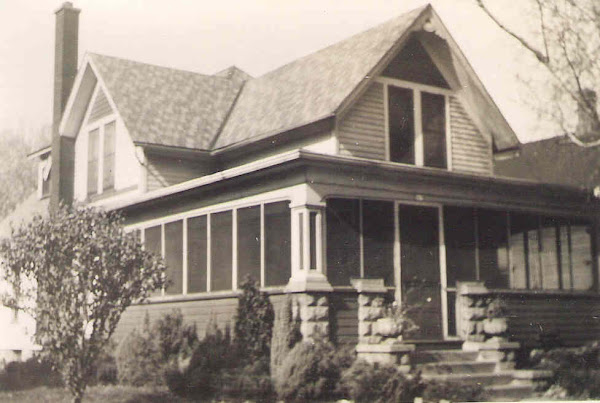
The Great American Porches of Huron’s Old Plat


Picture this: a hot summer day, a fresh lake breeze, and the chirp of crickets and the song of cicadas. Next, add a dose of tangy lemonade to be shared with good friends. Where would you place this scene? For me, the perfect setting is a beautiful front porch equipped with a squeaky swing and some wicker furniture. For centuries, Americans stayed in touch with friends and neighbors while staying cool on their front porches. The exact origin of the porch is unknown. In America, the addition of a front porch took hold first in the South where its function was two-fold: to cool the house by sheltering the interior rooms, and to provide a place for all social classes to relax and escape the intense heat of the sun.

Following the Industrial Revolution (1820-1870), porches became more commonplace due to greater affluence and machines that made building a house less difficult. In addition, shorter workdays afforded Americans more time to enjoy their families and their homes, while also enjoying the outdoors.

In Huron’s Old Plat neighborhood, the houses with the most impressive porches appeared during the Victorian Period (1840-1900). These porches typically contained elaborate spindle work and were often painted with multiple colors. Porches, which provide a link to the outdoors, fit well with the Victorian Period’s emphasis on healthful living and outdoor activities. Further, the rapid spread of tuberculosis during this period drove people outside in the pursuit of fresh air.

In subsequent years, the popularity of the front porch continued as house styles changed. Most houses for the next 50 years after the Victorian era contained porches. In the Old Plat, front porches are also found on houses built in the American Foursquare and Craftsman styles.

As our modern society progressed and air conditioning and televisions became more common, people withdrew to the indoors. In addition, houses in the post World War II society were being mass-produced without much regard for ‘extra’ architectural elements. People began to crave their privacy and no longer used their porches as a means of staying in touch with neighbors. Though porches did make a comeback for a brief time period, it is doubtful whether they will ever regain the importance they once held. Interestingly, there is a movement to re-establish the popularity of front porches and some planned neighborhoods are even requiring front porches as a means of neighbors connecting with one another. All in all, front porches remain a beautiful reminder of a simpler time and beckon us to sit down and watch the world go by.

Thursday, May 12, 2011

Portraits of Huron’s Past: Edward R. Hilton


The occupations of those living in Huron, Ohio, at the turn of the twentieth century varied as greatly as they do today. Around 1900, occupations of Huron residents included farmer, fisherman, shop keeper, etc. Edward R. Hilton’s occupation was a bit different from the norm in that he was a lumber salesman. Hilton was born in Detroit, Michigan, in 1868. At the age of 15, he left school and began working in Detroit’s lumber yards. Hilton’s work in the lumber industry ranged from logging to sawmill operator to commercial salesman. His financial success in the lumber industry came due to his extensive knowledge of the industry and his great enthusiasm. Hilton moved to Huron prior to 1890 and worked as a sales representative for various lumber companies, eventually representing three southern companies- Crossett Lumber Company of Arkansas, Enoch Brothers Lumber Company of Mississippi, and Ruddick Orleans Cypress Company of Louisiana.

After residing in Huron for only a few years, Edward Hilton moved to Toledo, Cleveland, and then Ontario. He returned to Huron and, in October of 1893, married Miss Mary Halladay of Huron. Through this union, two children were born: Ruth in 1896 and Edward, Jr. in 1903.

In April of 1905, Edward and Mary purchased a lot on Center Street for $625 and constructed a comfortable and attractive residence of eight rooms, which were all equipped with the most modern of conveniences and facilities. This grand house became the hub of social and family events for the Hilton family. Though Edward, Sr. traveled a great deal with his job, Edward and Mary were socialites and often entertained at their home. Edward was civically active and served as a trustee for the Children’s Home in Sandusky from 1917-1919. Further, Edward was a member of the village council in Huron and was appointed as mayor of Huron in 1920 during a time when no one else wanted the job. In addition, he was prominent in the Masonic organization, Knights Templar, and the Toledo Consistory.

Ruth Hilton, a graduate of Huron High School and Lake Erie College in Painesville, Ohio, married Lieutenant David Taylor at the home of her parents on November 29, 1919. The wedding came just one day before Lt. Taylor of Norwalk was to sail to France on military duty. The couple was stationed in many locations, but spent five years in the Philippines where all three of their children were born. Edward Hilton, Jr. attended college in Pennsylvania and eventually settled in Florida with his wife, Margaret.

Edward Hilton, Sr. died at his home in November of 1941. His funeral was held at the Center Street home, and he was buried in Scott Cemetery. Mary Hilton died in 1961. Though the Hilton family is gone from Huron, the house they built in 1905, located at 217 Center Street, stands as a reminder of an influential Huron family of the past.

Sunday, April 17, 2011

McCormick School Recommended for Listing on National Register

For Immediate Release - April 11, 2011

Contact: Kim Schuette, 614.297.2314 or 800-340-6131 or by email at kschuette@ohiohistory.org

State Board Recommends McCormick School To National Register Of Historic Places

(COLUMBUS, Ohio)- Members of the Ohio Historic Site Preservation Advisory Board voted Friday to recommend that the state historic preservation officer nominate McCormick School in Huron, Ohio to be listed on the National Register of Historic Places by the National Park Service along with four other Ohio properties.

Located at 325 Ohio Street, McCormick School, formerly known as Huron School, is a striking Art Moderne building. Built in 1943, it was the first concrete school constructed in Ohio and has been in continuous use as a school building by the Huron Board of Education. Art Moderne, although quite common style of architecture in the late 1930s, was rarely used for public building and was especially rare for schools. The building was designed Harold Parker, an architect in Sandusky, Ohio, who designed other notable building in the area, including the Register-Star News Building in 1920, the Commercial Banking and Trust Company building in 1924 Strobel Athletic Field and Stadium in 1937 and Madison Elementary School in 1939.

If the National Park Service, the agency that administers the program, agrees that the school meets the criteria for listing, it will be added to the National Register of Historic Places. The final decision to add a property to the register comes about 90 days after the National Register nomination is formally submitted to the park service by the Ohio Historic Preservation Office.

Tuesday, March 29, 2011

Portraits of Huron’s Past: George E. Rhinemiller


Ingenuity and good business sense never go out of style and are necessary components for success. Yet, success may not be all that it seems. One of the successful businesses owners of Huron, Ohio’s past was George Edward Rhinemiller. George was born on September 25, 1883 to John and Margaret Rhinemiller. The Rhinemiller homestead was located on Berlin Road in Huron. George attended the public schools in Huron and then completed a technical course through the International Correspondence School of Scranton, Pennsylvania. In addition, George likely received practical training from his father who was known as a respected and prosperous farmer who always employed the latest farm implements.

George’s first adventure in the business world was in 1908 when he established a farm implement trade in Huron. He sold the most innovative and modern farm implements available, including the Hoover Potato Digger, which was produced in Avery, Ohio. George’s next venture was a sand and cement business. George’s greatest business success, however, came when he established an automobile sales and service business. In 1912, he erected a three-story, brick building at 607 South Main Street, Huron, which housed a showroom, garage and repair shop that had the most modern mechanical equipment. George was an agent for Oldsmobile, Chandler, and Chevrolet motor cars and Vim light delivery cars.

By 1915, George had abandoned his other ventures to focus his efforts exclusively on his automobile business. George became known as one of the most successful automobile salesmen in northern Ohio. In addition, he employed assistant agents in both Berlin Heights and Norwalk.

Around 1904, George married Bertha Jarratt, the daughter of Isaac and Martha (Harris) Jarratt of Huron. A son, Edward George, was born to George and Bertha in 1909. In 1910, George and Bertha built “an attractive and modern house of nine rooms” located at 513 Williams Street. Of course, the Rhinemillers also constructed a garage for their automobile.

Though success came for George Rhinemiller in the form of a profitable business, his personal life was struck by tragedy. In 1917, George’s son, Edward, died at the age of eight after a short illness. This tragic event seemingly sent George’s life into a downward spiral. By 1918, George and Bertha were living at the Reiger Hotel in Sandusky, and George was running the Rhinemiller Garage located on Jackson Street in Sandusky. In 1920, George no longer had his own business and was employed as the manager of an auto store. By 1925, George and his wife, Bertha, had divorced.
According to the 1930 census, George had married a woman named Florence, fathered two children, Betty Jane and George, Jr., was living in Rochester, New York, and working as an automobile banker. (Bertha Rhinemiller had moved to Cleveland and worked as a waitress.) The difficult times of the Great Depression greatly affected the profitability of the automobile industry with automobile sales down by 75%. This decline personally affected George Rhinemiller. On May 24, 1933, apparently despondent over failed business transactions, George committed suicide. His body was returned to Huron for burial in the McMillen Cemetery. George’s life, like so many others during the Great Depression, ended so pointlessly.

Friday, March 11, 2011

Tufa Rock Houses

Have you ever seen the handful of houses in the Huron's Rye Beach neighborhood that are constructed using a strange-looking, porous rock and wondered what exactly it was? The rock is called tufa. Tufa is a porous rock formed by the deposition of calcium carbonate from supersaturated water. According to Mike Angle, a geologist with the Ohio Division of Geological Survey, tufa and its sister, marl, are “a bit of an enigma for geologists to classify.” These rocks differ from all other bedrocks in Ohio because, unlike limestone and other bedrocks that are millions of years old, they are still being formed. Tufa, a soft, volcanic-looking rock that ages and hardens in the sun, is essentially a porous deposit of calcium carbonate. “It will form anywhere where ground water is super-saturated with calcium carbonate” states retired Ohio geologist, Nate Fuller. When the precipitation of the calcium carbonate occurs underground, marl is formed. When it precipitates out above ground, tufa is formed. Upon settling, the carbonate encrusts those objects with which it comes in contact.

Large deposits of tufa and marl are fairly rare and not very widespread; yet, small quantities of tufa rock can be found throughout western and northern Ohio. Deposits of tufa and marl are associated with areas containing caves or caverns and/or seeps or springs along relatively steep slopes and valleys. In Ohio, the largest deposits of tufa were traditionally found at White’s Landing, the Resthaven Wildlife area just northeast of Castalia, and the area around Miller’s Blue Hole, all in Erie County near Sandusky Bay.

In all areas where it occurs, the majority of the tufa and marl has been mined. At Resthaven, the largest deposit in the state, tufa/marl initially covered an area of about 3,500 acres and averaged six feet deep. This area was mined extensively in the early 1900s by the Portland Cement Company of Sandusky for use in their cement products. At White’s Landing and other areas, including Huron’s Rye Beach neighborhood and the Catawba Cliffs neighborhood, the tufa/marl was used primarily in the construction of homes, most of which were constructed during the 1920s and 1930s. Today, tufa is used widely in rock gardens around the world and provides a perfect substrate upon which to grow plants including Dianthus, Hosta, and Phlox.